Tuesday, December 3, 2013

Katakana Literary Work (Final)

This is a short manga that I drew using katakana words:

トレシー - "Tracy," foreign name.
フローズン - "Frozen," foreign animated film.
ウーン - "hmm," onomatopoeia.
ジョン - "John," foreign name.
ナニ - "なに," I decided to use katakana here for emphasis.
ウウウウウッ - Crying noise, onomatopoeia.  I added a small ッ at the end to show that the sound effect continues and reverberates.
エイエムシ- "AMC," foreign movie theater chain.


Thursday, November 21, 2013

About me (cont'd)

おはようございます。ピーターです。みんなさんおげんきですか。

先週はとてもいそがしかったです。今週よりいそがしかったです。でんもたのしいかったです。ロースクールのともだちとダンスパフォーマンスをしました。そしてブレークダンスをしました。

わたしはスポツのなかでブレークダンスがいちばんすきです。1週かんに2かい学校へブレークダンスに行きます。

とてもたのしいです。

どうぞよろしく。

Wednesday, November 13, 2013

Katakana Literary Work (Draft)

This is a short manga that I drew using katakana words.  I've used ウーンto express the sound for "hmm" and ウウウウ to express the sound effect of a person crying.  In both instances, I used katakana for onomatopoeia.

This is just a draft for now, but I hope to expand on the story and add more katakana usages for the final version.

Monday, October 28, 2013

Katakana Analysis (Final)

  • エドパック
I found this box of crackers at the local Asian supermarket and noticed that "Edo" was written in katakana (エド)rather than its usual kanji (江戸).  I thought that perhaps the manufacturer chose to use katakana for aesthetic purposes, so that both the words "エド" and "パック" would have a consistent appearance.  Perhaps the manufacturer also wanted to give the crackers a Western rather than an Asian feel.  Thus, while "パック" conforms with the use of katakana for a foreign word (pack), as explained in Japanese language textbooks, "エド" seems to be used for purely marketing and aesthetic purposes.  Thus, "エド" does not fall into any of the textbook explained categories of foreign words, onomatopoeia, technical terms, or plant names.  However, Wikipedia notes that katakana is sometimes used for the names of Japanese companies, which would apply here if the company were Japanese.  The company (Edo Trading Company) is in fact based in Hong Kong and not Japan.  As one commentator suggested and I inferred, the company might have purposely used katakana to avoid using Chinese characters and being characterized as a local brand.
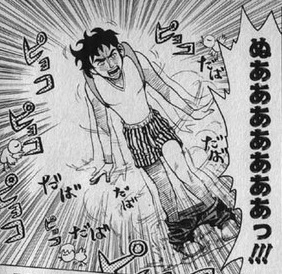
  • ピョコピョコ:Onomatopoeia

I found this picture online from the manga Sexy Commando Gaiden: Sugoi yo!! Masaru-san. The katakana used for "ピョコピョコ" conforms with the use for onomatopoeia as explained in Japanese textbooks.  As one commentator explains, the manga character is embarrassed because his pants fell off, so he is shivering and hopping quickly in shame.  "ピョコピョコ" represents the onomatopoeia for hopping or moving in short, quick steps.  

I found it interesting that the author chose to use katakana for some sound effects and hiragana for others.  Perhaps the author wished to distinguish the different sound effects more clearly by using different types of writings for each.  I have not studied enough Japanese to feel a sharp change in nuance between hiragana and katakana sound effects, but I feel that the author must have intended a difference.  
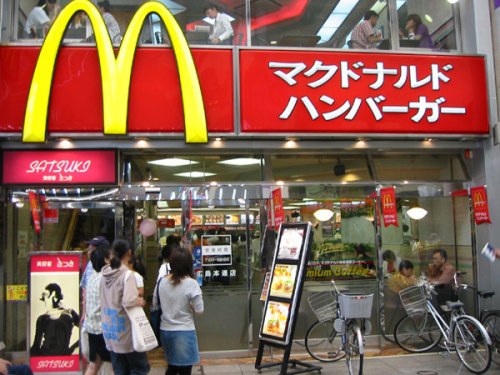
  • マクドナルド ハンバーガー  


 Here's a more obvious sample.  "マクドナルド" fits neatly in the textbook category of a foreign        name (McDonald's), and "ハンバーガー" fits in the category of a foreign word (hamburger).    


Monday, October 7, 2013

Katakana Analysis (Draft)

  1. エドパック
    I found this box of crackers at the local Asian supermarket and noticed that "Edo" was written in katakana (エド)rather than its usual kanji (江戸).  I thought that perhaps the manufacturer chose to use katakana for aesthetic purposes, so that both the words "エド" and "パック" would have a consistent appearance.  Perhaps the manufacturer also wanted to give the crackers a Western rather than an Asian feel.  Thus, while "パック" conforms with the use of katakana for foreign words, as explained in Japanese language textbooks, "エド" seems to be used for purely marketing and aesthetic purposes not explained by the textbooks.  
  2. ピョコピョコ:Onomatopoeia
    I found this picture online from the manga Sexy Commando Gaiden: Sugoi yo!! Masaru-san.  Although the katakana used for "ピョコピョコ" conforms with the use for onomatopoeia as explained in Japanese textbooks, I found it interesting that the author chose to use katakana for some sound effects and hiragana for others.  Perhaps the author wished to distinguish the different sound effects more clearly by using different types of writings for each.  

Thursday, September 26, 2013

カタカナ Samples

  1. エドパック:Name of product(?), aesthetic emphasis (?)
    Edo is normally written in kanji as 江戸.  Why is it written in katakana instead?
  2. ピョコピョコ:Onomatopoeia

Monday, September 23, 2013

自己紹介 I

はじめまして。ピーターです。コロンビアだいがくのだいがくいんせいです。アメリカのアトランタからきました。ははとちちはちゅうごくのこうしゅうからきました。

わたしはコロンビアだいがくでにほんごをべんきょうしますからにほんごがすこしわかります。でもまだエレメンタリーですからにほんごがあまりじょうずじゃありません。わたしたちはいまからかんじをならいます。

わたしはスポツとダンスがすきです。そしておんがくもすきですがうたがへたです。でもわたしのともだちはまいしゅうカラオケへいきますからうたがとてもじょうずです。

どうぞよろしく。