- エドパックI found this box of crackers at the local Asian supermarket and noticed that "Edo" was written in katakana (エド)rather than its usual kanji (江戸). I thought that perhaps the manufacturer chose to use katakana for aesthetic purposes, so that both the words "エド" and "パック" would have a consistent appearance. Perhaps the manufacturer also wanted to give the crackers a Western rather than an Asian feel. Thus, while "パック" conforms with the use of katakana for foreign words, as explained in Japanese language textbooks, "エド" seems to be used for purely marketing and aesthetic purposes not explained by the textbooks.

- ピョコピョコ:Onomatopoeia
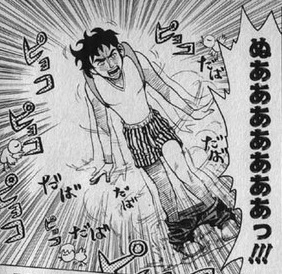 I found this picture online from the manga Sexy Commando Gaiden: Sugoi yo!! Masaru-san. Although the katakana used for "ピョコピョコ" conforms with the use for onomatopoeia as explained in Japanese textbooks, I found it interesting that the author chose to use katakana for some sound effects and hiragana for others. Perhaps the author wished to distinguish the different sound effects more clearly by using different types of writings for each.
Monday, October 7, 2013
Katakana Analysis (Draft)


Subscribe to:
Post Comments (Atom)
For the sample 1, エド could be written like in Chinese character 江戸 but I think this product was made in other Asian country like China, so they printed in katakana. Next, パック would be written in katakana because パック came from the English "pack" The meaning is similar.
ReplyDeleteSecond, for example 2, ピョコピョコ is a onomatopoeia for something hopping or moving in short quick steps. In this picture, the man in ashamed because his pants was get off so he was moving quickly and shivering his arms and legs.
ホンさん、
ReplyDeleteおもしろいですね!
If 「ピョコピョコ」was written in Hiragana like 「ぴょこぴょこ」and/or 「だばだば」、「ダバダバ」、then the impression or nuance would be different to you? Why do you think the author chose 「ピョコピョコ」over 「ぴょこぴょこ」and 「だばだば」over 「ダバダバ」?
やあピーター!ちょうしはどう?げんきにしてる?
ReplyDeleteEvery monday, I play volleyball in my university's college.
The team is not so strong but we enjoy playing volleyball.
My position in the team is setter.
It is a hard position but I want to improve my skill so I'm training myself.
So, hows your katakana study going on?
わからないことがあったらなんでもきいてね!では!
ピーター, I think your analysis is pretty interesting. In the first case, it may rise some questions for non-japanese speakers that why EDO instead of usual Kanji 江戸 is used. What might non-Japanese speakers think about EDO usage? Can you make some link or comparison with the book explanation?
ReplyDeleteAlso, just a remind, we need to write analysis on three examples.
やあピーター!いそがしいのかな?がんばれ!
ReplyDeleteThis sunday, I took a TOEFLiBT test for studying abroad next year.
I not sure to studyind abroad but this test was the last chance for the next year's study abroad so I took it.
That was the first time to take the TOEFLiBT so I was quite confusing but my friend gave me a lot of advise so I tried hard.
Even if the score was not high, I tried my best, so there is no regret.
Have you ever taken TOEFL test?
If yes, how was it?
おへんじたのしみにしています。じゃあね。まさきより。
こんにちわ!Unfortunately I have not taken the TOEFL test. Back in high school, we took the SATs in preparation for college. Do you know if they're similar? In any case, good luck to you - I hope you can study abroad. Have a great weekend!
ReplyDeleteAnd thank you all for the helpful comments!
ReplyDelete